
meet alamat.
what does it mean to be a 'pinoy pop' group?

I know I promised essays on like a million other topics, I just really had to get this outta my system, so here we go.
Intro.
It honestly makes more sense to me for the Philippines to be producing boy bands and girl groups than any other country, so when I heard about a boy group whose concept was showcasing Filipino culture through their music, I was extra excited. At the risk of overstepping: I’ve always found it kind of odd that few idol groups within the genre seemed to have done this sort of concept before; K-pop groups are known to do at least one song or performance that embodies traditional Korean art, music, and fashion (i.e. BTS’ ‘Idol’ or IVE’s ‘Heya’). J-pop groups are often seen wearing stylishly modernized versions of their own cultural garb as well. It was only a matter of time before P-pop did the same.
Alamat released a concept teaser before their debut in 2021. Their group name means ‘Legend’ in Tagalog; if you search the word you will often get Filipino folklore and stories in the results! This sets an expectation that despite their musical influences pulling heavily from ‘Western’ or otherwise non-Filipino genres like R&B, their roots remain in their home country and there will likely be references to some part of their own culture and history - be it from the Philippine’s colonial history, pre-colonial/indigenous folklore and local practices, or aspects of modern-day Pinoy culture.
With that being said: I’m not Filipino. I’m a first-gen Black American who is just really into idol groups and is generally curious about cultures that are not my own. It’s likely that no matter how much research I do, I’m bound to miss some key cultural context, so I’ll be sticking to brief explanations and relevant facts about this group, introducing their discography, and some thoughts on the implications of their concept. So, let’s start where any ‘Introduction To’ YouTube video would:
Members:
Alamat as of 2024 is a 6-member group that debuted under Viva Artists Agency, which appears to be under the parent company Viva. As such, a few movies released by Viva One (the branch of the company that produces…well, movies) feature one or more members as side or background characters. But who are they? Here’s a really quick rundown:
Taneo (Brylle Jordan Sebastian Uyam) - Aged 24, Taneo is the group’s Fil-Am representation. He is Kalinga/Ilocano and thus is the representative for that region and sings in that language. He is the group’s leader and handles the lower harmonies along with Jao as a sub-vocalist and rapper.
Mo (Aaron Joshua Baldos Mitchell) - At age 22, Mo is listed as the group’s co-leader (though I’m unsure if this is still the case) and is of mixed Black American and Filipino decent. Though his nationality/ethnicity is often referred to as just ‘American’, he actually hails from Castillejos, Zambales. His main language appears to be Tagalog, and he serves as the group’s main rapper and main vocalist simultaneously.
Jao (Justin Paolo Paras Canlas) - Jao is the youngest (‘bunso’) in the group at age 21. He sings in Kapampangan in correspondence to his nationality. He’s the group’s main dancer, and a sub-vocalist.
R-Ji (Ralph Joseph Baleña Lim) - At age 25, he is one of the eldest members along with Tomas (the official eldest). He shares the lead vocalist position with Mo, often taking on the higher harmonies. He is Waray-Waray, and thus sings in the respective language.
Alas (Joshua Magsilong Alvarez) - Alas is one of the ‘middle children’ at 23 and is the group’s other lead rapper (though he does sing when necessary, and quite well). He represents the Bisaya people and language.
Tomas (Thomas Franco Torre Rodriguez) - Aged 25, Tomas is the group’s oldest and other official lead dancer, our third main vocalist, and representative of the Bicol region.
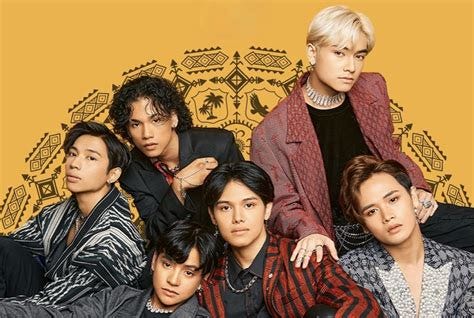
Though there are currently six members, four members left the group either before or shortly after debut. This profile lists former members if you’d like to learn about them, but I’ve decided to be as brief as possible here and only list active members. Here’s a group photo:
Discography
As previously mentioned, Alamat debuted officially in February of 2021 with their first single ‘KBye’, a bright, laid-back song that is also about desperately asking your lover why they left you. The music video matches its sound more than its lyrics, with bright neon colors incorporated into the set and the members’ outfits. The mixing is…questionable, and you can definitely tell that they just got here, but hey, the song’s cute!
Later in the same year, the group made good on their promise of staunchly anti-colonial messaging with ‘Kasmala’, a sleek, fast-paced, anthemic banger whose music video references the experiences of Filipinos during American occupation (may the empire fall <3). It’s also when I first heard of the group via Twitter! The costuming references indigenous clothing combined with modern silhouettes, as well as the uniforms of Filipino resistance fighters in Mo’s case.
Unlike the more relaxed debut single, Kasmala’s beat is relentless, the chorus feeling like you’re marching into battle. It contains rapid-fire rap verses from multiple members (some of the former members can be seen here and in subsequent releases up until the start of their ‘Pasulong’ era), as well as layered vocals all the way through. P-pop groups will never pass up an opportunity to harmonize. It’s one of my favorite releases from them to this day!
The group released a cover of ‘Porque’ that same year (a song by another artist under Viva), as well as ABKD (in which the issue of colorism is addressed) and the ballad ‘Sa Panaginip Na Lang’ in 2022 as non-album singles. It is not until October of that year that their first Extended Play ‘Pasulong’ is released, matching the spirit of the season with darker and more sultry sounds, lyrics, and dance moves. It also contains their most viral single to date: Maharani. The music video stars member of P-pop girl group Bini, Jhoanna Robles, singer Migo Valid, and of course, Alamat. It features tinikling dance quite prominently, as well as traditional fabrics and patterns for the group’s costumes.
We’re finally bringing back music videos with plot!
Other standout tracks (in my humble opinion): ‘Aswang’, ‘Say U Love ME’, and ‘ILY ILY’ (often dubbed “p-pop’s Bohemian Rhapsody”, which should tell you a lot).
2023 saw the group release their second Extended Play, ‘IsaPuso’. It starts off with a bang with Kasmala’s older, cooler cousin: ‘Dagundong’. Like ‘Kasmala’, this track touches on a dark era of colonialism, this time in reference to the Spanish colonial period. It is more explicitly rap-forward, utilizing heavy bass and snares as a canvas on which to paint bold narratives of anti-colonial resistance. Just…watch the music video. It speaks for itself, honestly.
On the flip side of things, in 2024 Alamat did a hard pivot into a much brighter concept with the release of the music video for ‘Dayang’, the second track on their EP. It’s summery, it’s fun, and the lyrics are (at least partially) in Tausug! Like Maharani, the choreography incorporates movements that draw on local traditions, with Dayang containing Filipino martial arts movements, if I recall correctly. It’ll get stuck in your head fast.
In the second half of 2024, Alamat is set to release their newest single ‘Hiraya’, which sounds like a really bright city-pop esque track based on the teasers! Many fans have commented that it reminds them of K-pop group Seventeen’s discography. We also got a sneek peak at the choreography from Alamat’s official social media! I could be wrong, but it appears that they’re continuing to incorporate Filipino cultural dances in this one as well.
Update: As of me editing this for typos on 11/19/2024 at 11 AM EST, the lyric video is now available! It’s such a cute track (I know I keep describing songs this way, but it really is cute)
Not your average idols
P-pop is already quite different in its landscape and general ‘vibe’ than its East Asian counterparts; idols are allowed much more leeway to speak up for themselves when fans cross boundaries, and interact with their fanbase directly and frequently. They also stand out aesthetically with a tendency towards a sort of maximalism that feels distinctly Filipino. Bini’s concert outfits? Gorgeous. All this is to say, P-pop already breaks a lot of ‘rules’ so to speak, but Alamat takes this to another level by embodying their concept within the fabric of the group itself.
If you’re already familiar with how idol group positions work: did you notice a particular position that was distinctly missing from the list?
That’s right, Alamat has no ‘visual’ position. They mentioned on their social media page that the group intentionally abolished it (though previously they had just listed everyone as a visual), as it was decided that essentially upholding one member as “the pretty one”, or even acknowledging the position at all, would implicitly enforce a singular, rigid standard of beauty, which would contradict the group’s commitment to diversity. It should be noted that—at least compared to their peers and other Filipino celebs—a few members are visibly darker-skinned when seen in unedited photos (skin color is obviously relative; I’m much darker than Mo, for example). Their diversity is embodied in the sheer variety of skin tones, facial features, languages and accents. They aren’t just presenting a concept, they are the concept.
This is also part of why members leaving the group presents additional challenges: each member is meant to be representative of his respective region/ethnicity and its corresponding language(s); former member Valfer, for example, was the group’s Hiligaynon/Ilonggo speaker. You lose a member, you lose a language. Having non-native speakers still attempt to sing in that language presents a degree of risk. Concerns about the risk of unintentional appropriation of indigenous cultures have frequently been brought up in fan discussions and interviews. However, these are really conversations that only Filipinos can have intra-communally, so I’ll stay out of that one.
The diverse backgrounds of the members also provide insight into different dimensions of what it means to be Filipino outside of local ethnicity. For example: What does it mean to be mixed—more specifically black—in the Philippines? Mo has been on the receiving end of multiple microaggressions and comments from non-fans seemingly confused about his race: some disparaging his choice to wear his hair in locs as appropriation (before realizing he is biracial, of course), questioning his choice to reclaim the n-word (most if not all of the people making these critiques are non-black Filipinos who would have no say in either of those conversations, mind you), and even suggesting that his choice to wear Black cultural hairstyles somehow contradicts the group’s ethos.


He is ethnically half Black American, but has lived in the Philippines for what I assume to be his entire life, or most of it (in one of their vlog he states that he’s never met his sister, who lives in North America, in person). What is his relationship to Black American culture if his interactions with the actual community at large are often limited by physical distance (I’d imagine the interently gloabalized landscape of social media complicates this)? Why is Blackness constantly positioned as mutually exclusive to or the antithesis of other ethnicities? (I think I know the answer to that one.) What is his relationship to Black music? He covers songs from the likes of Lucky Daye and Bryson Tiller quite often. Do I even have the right to be asking these questions if I barely know the guy beyond the facts he’s chosen to divulge about himself on the internet?
Taneo is not mixed racially, but as previously stated, he is Filipino-American. I can’t hear it personally, but I’m told by fellow fans based in the Philippines that traces of an American accent linger on his tongue when he speaks. This often leads to some fans jokingly calling him ‘conyo’: a term used in part to refer to upper-class Filipino youth that (presumably) speak English alongside Tagalog with much greater proficiency in English, if they speak Tagalog at all. Now I don’t know what his family’s tax bracket is, but statements like that seem a bit presumptuous.
Again, not my conversation to have, and actual Filo readers can correct me here, but generally I can’t help but wonder how he feels about having his speech constantly under the microscope like that. P-pop groups across the board are already constantly facing barrages of criticism for not being ‘Pinoy enough’. Does Alamat’s concept—which explicitly proclaims itself to be embodying Filipino-ness in all its forms—exacerbate this dynamic?
Well, they’ve only been around for three years. I guess only time will tell.
The capitalist monster consumes all.
Okay, I’m being a bit dramatic with that title, but follow me:
I’ve already mentioned the risks of cultural appropriation with a group like Alamat (and yes, cultural appropriation is something worth discussing in a post-colonial/neocolonial world in which cultural exchange occurs under the conditions of unequal power dynamics. It is the by-product of a larger system of colonialism, capital and the extraction of marginalized people’s labor, blah blah blah). But I haven’t yet addressed the looming issue of what may happen once the group’s hype inevitably goes overseas (it’s already happening - they had a concert a few months back in Canada, and I’m here - writing this article from New York City).
The K-pop wave, as well as the popularity of Japanese pop culture via J-pop and anime, have resulted (albeit intentionally) in the packaging of these respective cultures as products to sell to an international audience in exchange for soft power and that sweet sweet tourism revenue. I don’t know if P-pop is established enough just yet to become a full-on cultural export, but boy do I see it coming (that is, if management companies can start properly promoting their groups enough for the genre to proliferate itself). What would that mean for the ways in which Filipino culture is engaged internationally?
Again, Alamat incorporates traditional elements in all that they do. What are the implications of turning their choreographies into TikTok challenges? If you do the moves wrong, or they are watered down, is that disrespectful? There’s also one big elephant in the room that I’ve seen nary a fan even try to address: they’ve already engaged in cultural appropriation, unintentionally.
Despite the incorporation of instruments and sounds indigenous to the Philippines into some of their music, R&B and rap still make up a majority of their catalog when it comes to their overarching sound as a group. The appropriation of Black (American in particular) music has been so normalized that folks often forget that it’s connected to a living people who don’t seem to have much say in what happens to our culture, and who benefits from it.
Of course, it should be noted that our music and artists are quite popular in PH, but consumption is not community. And no, I don’t quite think having one single, solitary biracial man in the group shields them from this critique by association. That’s not really how that works. The group’s set to release a collaboration with French Guianese artist Karl Wine, which draws heavily upon Caribbean influences for its sound. One of the confirmed lyrics is: “dem gyals Filipina”. Hm. I don’t think the average Filipino says things like that. But anyway…
All in all, no matter how sincere they may be in their cultural advocacy, Alamat is still beholden to the whims of a capitalistic industry and media landscape that consumes everything it touches. They’ll never be able to avoid it all, but I’m curious to see how they respond to it.
Conclusion + favorite songs:
Alamat might be the most interesting boy group I’ve encountered in a while. They embody their concept beyond surface level visuals and aesthetics, representing multiple facets of the Filipino experience. They have a very welcoming and accommodating fanbase (named ‘Magiliw’ officially), who make sure to explain various cultural references that the group makes in their music and visuals and are happy to translate lyrics and such. I have a lot of fun interacting with other fans!
I’ll leave you with a list of my favorite tracks:
‘Maharani’ (it’s famous for a reason)
‘ILY ILY’
‘Dagundong’
‘Say U Love Me’
‘Kasmala’
‘Day and Night’
‘Multo’
Thank you for indulging yet another weekly info-dump <3
Just finished reading and I'm surprised you don't have more readers! I love your dissection of this topic, even as someone who doesn't know as much about P-pop or Alamat specifically. What a good read!
OMGGG i was browsing ur feed and loved the tumblr vibes i was getting and i thought this was the sign u were also Filipino but im glad to see u enjoying music from my country!!!!